
The rules of industrial cybersecurity changed in 2026.
For years, the standard playbook held: segment your network, deploy a firewall at the IT/OT boundary, monitor for anomalies, patch what you can. That playbook assumed attackers were human, that reconnaissance took weeks, and that a well-configured perimeter bought enough time to detect and respond.
In September 2025, a Chinese state-sponsored group ran a full intrusion campaign across 30 organizations with an AI agent handling 80 to 90% of operations, at thousands of requests per second. Human operators checked in at four to six decision points. The machine ran the rest.
For OT operators running PLCs on firmware from 2012, the math has fundamentally changed.
What Industrial Cybersecurity Actually Covers
Industrial cybersecurity is the protection of Operational Technology (OT), the hardware and software that monitors and controls physical processes from cyber threats that can cause operational disruption, physical damage, or safety incidents.
It’s distinct from IT security in one critical way: the consequences are physical.
A breach in an IT environment means data loss or financial damage. A breach in an OT environment can mean an uncontrolled chemical process, a power grid offline, or a pipeline shut down for six days. The systems at risk include:
- PLCs (Programmable Logic Controllers) : automate discrete manufacturing and process control
- SCADA systems : provide supervisory control and real-time visibility across distributed sites
- DCS (Distributed Control Systems) : manage continuous process environments like refineries and power plants
- RTUs (Remote Terminal Units) : collect field data in remote or unmanned locations
- HMIs (Human-Machine Interfaces) : the operator touchpoint for monitoring and control
- SIS (Safety Instrumented Systems) : the last line of defense commanding emergency shutdowns
That last category matters more than most operators realize. The 2017 TRITON/TRISIS attack specifically targeted a Schneider Electric Triconex SIS at a Saudi petrochemical facility, designed to disable emergency shutdown capability. Attackers understand the architecture. Defense has to as well.
Who Needs It
Any organization that runs physical processes through automated systems is in scope. The sectors with the highest exposure:
Energy and utilities : power generation, transmission, water treatment, wastewater. Prime targets for nation-state actors seeking to pre-position capabilities for future disruption.
Oil and gas : upstream, midstream, downstream, pipelines. The 2021 Colonial Pipeline attack took 600,000 barrels per day offline for six days through an IT compromise that forced an OT shutdown.
Manufacturing : automotive, aerospace, pharmaceuticals, food processing. Production lines running on legacy OT that was never designed for network connectivity.
Defense and government : classified networks, sovereign infrastructure, defense manufacturing. Cross-domain data transfer requirements that demand hardware-enforced isolation.
Transportation and healthcare : rail systems, airport operations, medical device networks. Convergence with IT and cloud infrastructure creating new attack surfaces faster than security teams can address them.
The common thread: operations that cannot tolerate unplanned downtime, where a cyberattack has physical consequences.
Why OT Environments Are Uniquely Exposed
Legacy systems that can’t be patched
Most OT environments run equipment installed a decade or more ago. PLCs, RTUs, and HMIs operating on end-of-life firmware, from vendors who may no longer exist. Patching requires validated downtime that production schedules often can’t accommodate.
CrowdStrike’s 2025 research documents average time-to-exploit dropping dramatically over recent years. An unpatched OT asset is not a background risk at that speed. It’s an open position.
Protocols with no authentication layer
Modbus, DNP3, Profibus, HART, the field-level protocols that run most industrial environments, were designed for reliability in isolated networks. Authentication was never part of the initial brief. Although protocols evolution cover for some authentication, they are not always implemented in practice.
A device speaking plain TCP Modbus responds to any query from any host on the same segment. No credential required. No log entry generated. An attacker who reaches an engineering workstation can map every reachable device, read register values, and document process variable addresses without triggering a single alert.
The convergence problem
OT environments were air-gapped for decades, not by design in most sectors, but by technical incompatibility. Industry 4.0 has systematically dismantled that isolation. Cloud historians, remote monitoring platforms, SIEM integrations, vendor maintenance sessions, every one of these creates a data path between OT and IT.
Every data path created for operational efficiency is also a potential attack path.
The cloud layer adds a third tier to the problem. Platforms like Azure IoT Hub and AWS IoT Greengrass now sit between OT data sources and enterprise analytics. An edge gateway collects data from PLCs, normalizes it, and pushes it to a cloud endpoint. Each layer requires credentials. Each layer runs software that needs patching. Each layer is a potential entry point and understanding why starts with the fundamental differences between IT and OT environments.
The Threat Landscape in 2026
AI-orchestrated attacks have arrived
In September 2025, a Chinese state-sponsored group designated GTG-1002 ran the first large-scale cyberattack executed with AI handling the majority of operations without sustained human direction, confirmed by Anthropic. The framework used commodity penetration testing tools, orchestrated autonomously. Reconnaissance, vulnerability analysis, exploit generation, lateral movement running at thousands of requests per second.
No human team operates at that tempo.
The implication for OT operators: the detection windows that industrial security architectures were calibrated around have effectively closed for the fastest AI-orchestrated campaigns.When the attacker operates at machine speed, the arms race between detection and evasion has only one exit, and it’s not a faster classifier.
Ransomware targeting OT directly
Ransomware has evolved from IT opportunism to OT targeting. EKANS/Snake (2020) was built to terminate specific OT processes before encrypting. FrostyGoop (2024) exploited an exposed Modbus interface to cut heating to 600 apartment buildings in Lviv without any sophisticated lateral movement. It queried unauthenticated registers directly.
The attack didn’t need to be sophisticated. The protocol did the work.
Nation-state pre-positioning
Volt Typhoon, the Chinese state-sponsored group documented by CISA and Microsoft has been confirmed pre-positioning inside US critical infrastructure: power, water, communications. Not for immediate disruption. For future use.
These intrusions are characterized by long dwell times, living-off-the-land techniques, and minimal network noise. Detection-based defenses built around anomaly thresholds were not designed for this threat model.
The documented attack path: IT → OT
The incidents follow a consistent pattern. The IT network is the entry point. The OT network is the objective. Every major breach, Colonial Pipeline, TRITON/TRISIS, the Ukraine grid attacks, followed the same path, and the documented incidents tell the same story every time.
Attack vector | Mechanism | Documented example |
Phishing → IT pivot | Workstation compromised, lateral movement via VPN | Colonial Pipeline (2021) |
Firewall exploitation | Zero-day in perimeter device firmware | ArcaneDoor, Cisco ASA/FTD (2024) |
Compromised remote access | Vendor VPN session without adequate segmentation | Multiple O&G incidents, 2020-2023 |
Engineering workstation | IT-connected workstation with DCS access | TRITON/TRISIS (2017) |
Supply chain | Corrupted update through legitimate software channel | NotPetya / M.E.Doc (2017) |
Why Software Defenses Reach Their Limits
Firewalls enforce policies. Policies can be broken
A firewall is a configuration. Configurations can be misconfigured. In 2024, the ArcaneDoor campaign exploited zero-days in Cisco ASA and FTD perimeter devices, the security appliance enforcing the IT/OT boundary became the entry point. Fortinet FortiOS (CVE-2024-21762) and Ivanti Connect Secure were also exploited in documented 2024 campaigns, all tracked in CISA’s Known Exploited Vulnerabilities catalog.
The device protecting the boundary was the vulnerability.
Detection-based defenses assume time to respond
NDR and SIEM tools operating in near real-time can identify anomalous OT traffic but they cannot prevent the exchange from occurring. The query has already traversed the segment before any alert reaches an analyst.
Against an AI-orchestrated campaign running at machine speed, shorter dwell time still means the damage is done before a human can act on the first alert.
The escalation cycle favors the offense
AI-assisted attacks decompose malicious operations into thousands of individually innocuous-looking tasks. Each step looks like legitimate security testing activity. Behavioral classifiers see individual steps, not the campaign.
Evasion adapts faster than detection rules update. Any defense whose effectiveness depends on the attacker running low on patience is miscalibrated for 2026.
What Actually Works: Hardware Segmentation at the OT Boundary
The data diode principle
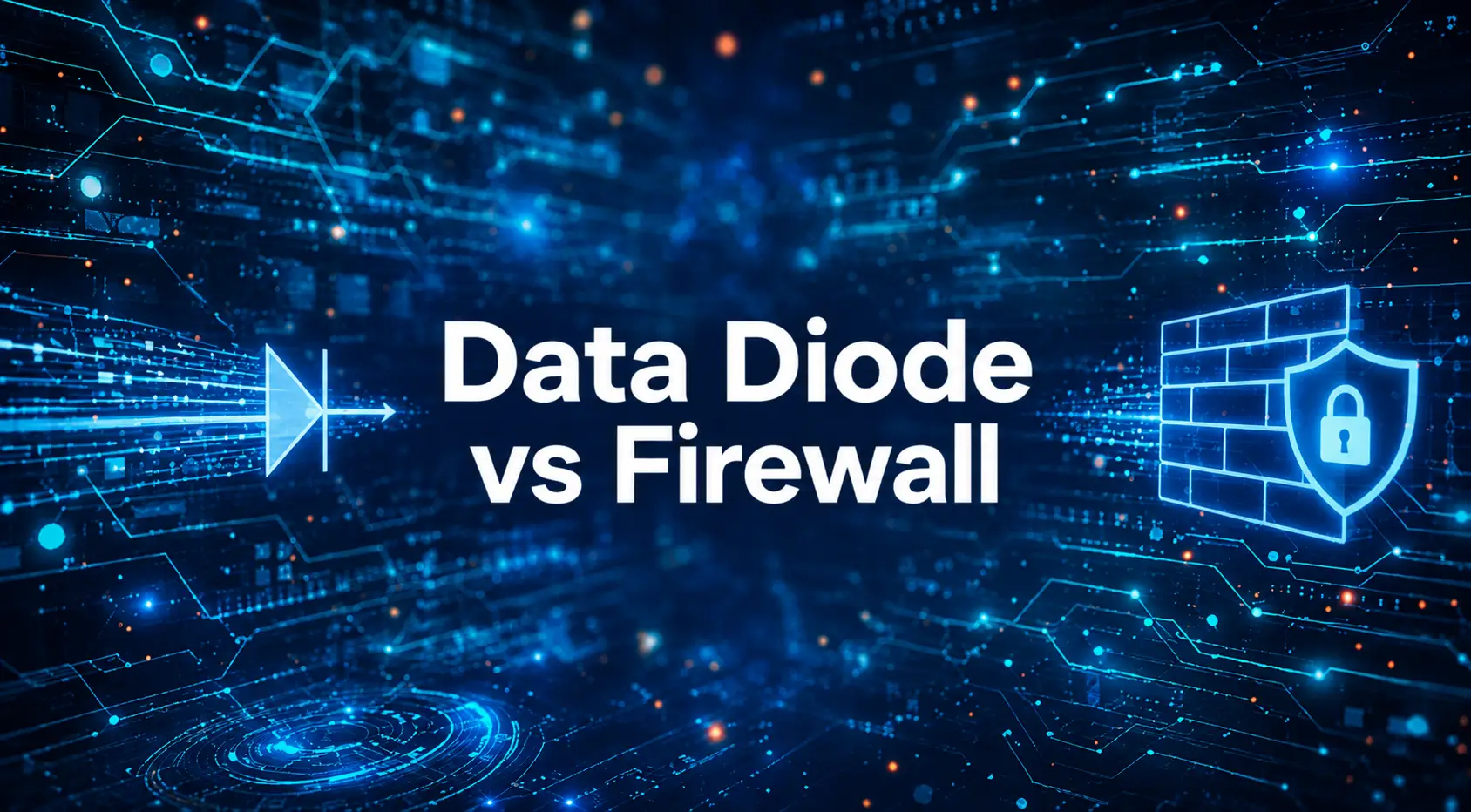
A hardware data diode enforces one-way communication at the physical layer using optical components. Data flows in one direction, typically OT to IT. The hardware architecture makes a return channel physically impossible.
There is no configuration to compromise. No firmware exploit that creates a return channel. No policy that can be manipulated. The directionality is a physical constraint, not a software rule which is precisely why hardware and firewalls are not equivalent tools for OT protection.
An attacker who has fully compromised the enterprise network still cannot reach the DCS, the SIS, or the OT historian because there is no return channel for any protocol to establish a session across.
What flows through and what doesn’t
One-way doesn’t mean operationally blind. The historian replicates time-series process data outbound to enterprise analytics. SCADA alarm exports reach the SOC SIEM. Security events from PLCs and HMIs forward to security operations.
The data that makes OT visible to the business crosses the boundary in the direction it needs to go. What doesn’t cross is any inbound path.
When IT needs to reach OT
Some workflows require IT-to-OT flows: firmware distribution, recipe synchronization, configuration pushes. A paired unidirectional gateway architecture, two hardware data diodes operating on separate, asynchronous paths, handles these through discrete, hardware-enforced, logged transfers. No persistent session can be maintained across the boundary.
SIS isolation: the boundary within the boundary
Safety Instrumented Systems warrant a separate network segment even within the OT environment, isolated from the operational DCS and SCADA networks. IEC 61511 and IEC 62443 SL3/SL4 both prescribe strict separation for safety-critical functions.
A hardware data diode enforcing the SIS boundary eliminates any software-exploitable path from IT, from the operational OT network, or from both.
Frameworks and Regulatory Requirements
IEC 62443 the international standard for industrial automation and control system security defines zones and conduits as the model for OT network architecture. Its highest security levels recognize unidirectional security gateways as a compliant control for enforcing zone separation.
NIST SP 800-82 provides practical guidance specifically for ICS security, with network architecture recommendations that account for OT operational constraints. Its Cybersecurity Framework (Identify, Protect, Detect, Respond, Recover) provides a structured methodology applicable to industrial environments.
NIS2, transposed into national law across EU member states, mandates risk-appropriate technical controls for operators of essential services (energy, water, transport) and extends to manufacturing in specific sub-sectors: medical devices, electrical equipment, motor vehicles, and chemicals.
NERC CIP applies to operators of the Bulk Electric System (BES) in North America high-voltage transmission and generation assets above defined criticality thresholds. It identifies unidirectional gateways as a compliant mechanism for crossing Electronic Security Perimeters.
The frameworks were developed independently. They converge on the same architecture.
Frequently Asked Questions
What is industrial cybersecurity?
Industrial cybersecurity is the protection of Operational Technology systems — PLCs, SCADA, DCS, RTUs, HMIs, and Safety Instrumented Systems — from cyber threats that can cause operational disruption, physical damage, or safety incidents.approaches inadequate.
Why are OT systems harder to secure than IT systems?
Three reasons: legacy equipment that cannot be patched, field-level protocols with no authentication layer, and operational continuity requirements that prevent standard security interventions. A PLC on a production line cannot be restarted for a firmware update on the same schedule as an enterprise server. Network-level isolation is a more reliable control than patch management for legacy OT assets.
What is the difference between ICS and SCADA?
ICS (Industrial Control Systems) is the umbrella term covering all control system architectures used in industrial environments. SCADA is a specific type of ICS that provides centralized monitoring and control across geographically distributed sites. Other ICS types include DCS for continuous process environments and PLC-based systems for discrete manufacturing.
What is a hardware data diode and why does it matter for OT security?
A hardware data diode enforces one-way communication at the physical layer using optical components. It allows data to flow from OT to IT while making an inbound attack path physically impossible. Unlike a firewall, there is no configuration to misconfigure and no firmware exploit that creates a return channel.
Which compliance frameworks apply to industrial cybersecurity?
The primary frameworks are IEC 62443 (international, all industrial sectors), NIST SP 800-82 (US, ICS-specific), NIS2 (EU, essential services and specific manufacturing sub-sectors), and NERC CIP (North America, Bulk Electric System operators). All four converge on hardware-enforced network segmentation as the appropriate control for high-security OT environments.