- Critical OT & Industry 4.0
- Hexagon PAS
- OT-to-IT
Case Study: Secure OT Alarm Dispatch to Remote Engineers
Leading Gas Company in the Middle-East (GCC)
Real-time dispatch of operational alarms and events
High exposure risk as engineers access notifications from external networks
Strict High Availability requirements with zero single point of failure
Need / Problem / Context
Secure Transmission of DCS Alarms with Hexagon PAS to Remote Duty Engineers
A large gas company operating critical industrial facilities needed to ensure that operational alarms and events generated by its Distributed Control System (DCS) — managed through Hexagon PAS Alarm Management — could be delivered to on-call engineers located outside the plant.
These alerts are essential for rapid response to abnormal conditions and operational incidents. However, the OT network hosting the DCS infrastructure had to remain strictly protected from Internet-borne cyber threats. Any direct connectivity toward external networks could have exposed critical operational systems to unacceptable cyber risks.
The challenge was therefore to automatically transmit DCS alarms and events from Hexagon PAS to remote engineers in real time, while maintaining strict isolation of the OT environment and preventing any inbound connectivity from external networks.

Solution Deployed
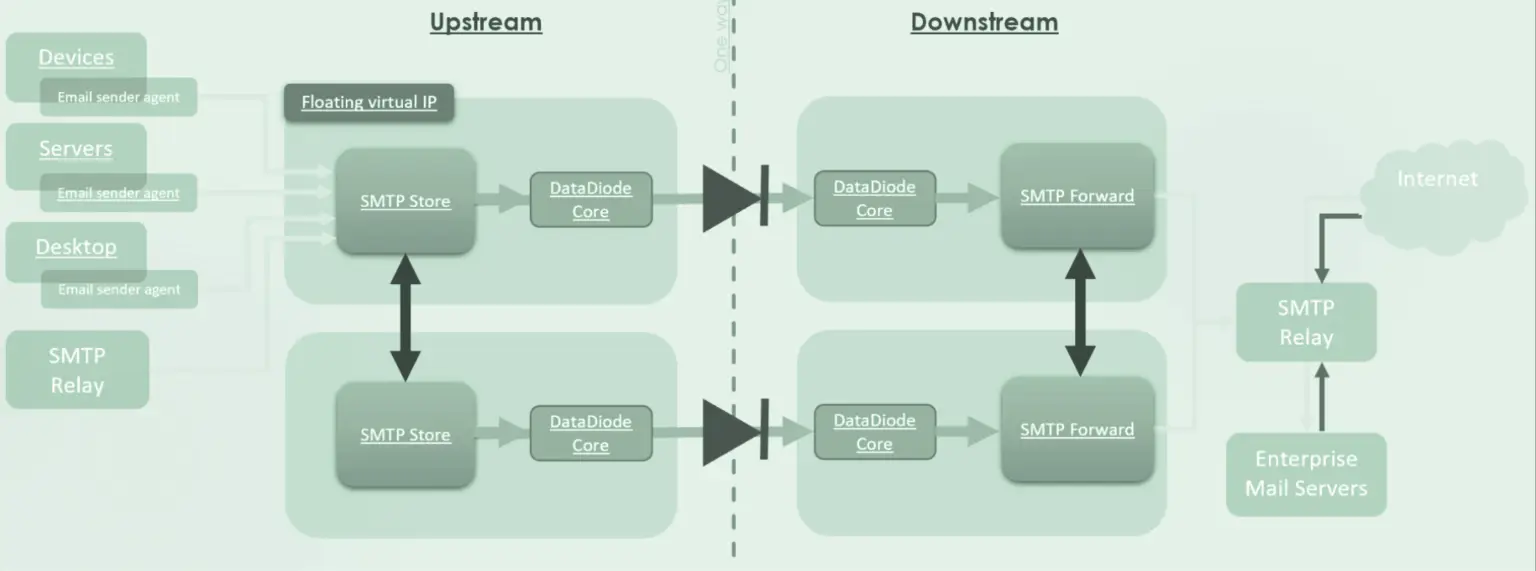
A Cyberium unidirectional gateway architecture was deployed to securely forward alarms and operational events from the OT environment to remote notification systems while preserving strict isolation of the control network. The solution enables automated alarm delivery to engineers outside the facility without exposing the industrial environment to inbound cyber threats.
2x OWA 3U pack @ 1 Gbps
Two unidirectional gateways were deployed to securely forward alarms and event data while maintaining strict separation between the OT control network and external communication systems.
High-Availability℗ Setup
Cyberium patented High Availability mechanisms ensure uninterrupted alarm delivery and eliminate any single point of failure in the notification workflow.
SMTP Connector
Operational alarms are exported through secure email messaging channels, enabling automated notification to on-call engineers and duty teams.
Outcomes & Benefits
The deployment enabled secure real-time dispatch of operational alarms to remote engineers while maintaining strict protection of the industrial control network.
Enabled remote duty service for engineers without requiring on-site presence
Improved operational responsiveness through automated alarm notifications
Achieved extremely low maintenance with 99.99% service availability
More use cases
- Critical OT & Industry 4.0
- OWA 2U/3U
- Custom SCADA, Siemens WinCC
- SQL Databases Agent
- Critical OT & Industry 4.0
- OWA 2U/3U
- Custom SCADA
- OPC UA Agent
- Critical OT & Industry 4.0
- OWA 2U/3U
- Cisco Splunk
- HTTP/S API, Syslog
- Critical OT & Industry 4.0
- OWA 2U/3U
- Custom SCADA
- SQL Databases Agent
- Critical OT & Industry 4.0
- OWA 2U/3U
- Hexagon PAS
- File Transfer Agent, SMTP
- Critical OT & Industry 4.0
- OWA 2U/3U
- Microsoft WSUS
- WSUS Agent
We secure the Critical
— connecting what should stay isolated.
Latest blog entries
- Engineering Insights
Key takeaways – Cybersecurity Hardware OT networks need different hardware than IT networks — the threat model and operational constraints (…)
- OT Cybersecurity Best Practices
Key takeaways A data diode enforces one-way data transfer at the hardware level — not through software rules, but through (…)
- AI & Cybersecurity
When a firewall sits at the boundary between your IT network and your OT environment, you’re trusting a policy. A (…)
- AI & Cybersecurity, Threat Landscape
The rules of industrial cybersecurity changed in 2026. For years, the standard playbook held: segment your network, deploy a firewall (…)
- AI & Cybersecurity, Threat Landscape
Most cyberattacks on industrial infrastructure don’t start in the plant. They start in the office. A phishing email reaches an (…)
- AI & Cybersecurity, Threat Landscape
In 2025, the baseline assumption of industrial cybersecurity broke. For twenty years, defenders had one reliable edge over attackers: time. (…)